
Your discovery calls were flawless, and your product demo was met with genuine enthusiasm. Your business case provided a clear, undeniable ROI and earned a nod from the economic buyer. The redlines are complete, all necessary security forms are signed off, and the contract is securely in the champion’s inbox, just waiting for a digital signature and a reply-all.
And then … nothing. Total silence.

Monday turns into Thursday, then slowly ages into a couple of quiet, tense weeks. Replies to your follow-up emails are met with vague but polite language, maybe using phrases like “internal alignment” or “sorting out some final scheduling details.”
What do you do when a late-stage deal stalls right at the threshold? Even experienced sales teams might fall back on experience and standard diagnoses. Maybe a competitor slid in at the last minute, or the budget got pulled. Maybe the prospect lost interest in the features.
But none of these answers feels convincing, and there’s a good reason for that. More often than not, your deal isn’t stuck because they suddenly decide they hate your product. Your deal stalled out because your champion is dreading the Monday morning after the contract is signed. Whether you call it cold feet or proactive buyer’s remorse, the result is the same: lost opportunity, wasted effort, and a dead deal.
Here’s how you can spot this hidden deal-killer—and how you can use a post-signature blueprint to neutralize it before it can derail your quarter.
Understanding “Proactive Buyer’s Remorse”

We’re all familiar with conventional buyer’s remorse. It’s the wave of regret that happens right after a purchase, maybe when the product you’ve just committed to fails to live up to its hype or when the realization of just how high the cost is sinks in.
This regret isn’t something you want a customer to experience, but the solution depends on the integrity of the salesperson and the actual value of the product. Buyer’s remorse will kill repeat business and, over time, typically spells doom for a company with dissatisfied customers.
Proactive buyer’s remorse is worse. It can kill good deals that benefit both parties, and it can do it right before purchase. It’s a psychological freeze response caused by a sudden, overwhelming fear of the operational workload required to make the new solution work.
It happens because when a buyer looks at a contract, they’re seeing an avalanche of impending work just on the other side of the signature line. They might be worried about extracting legacy data from old systems, convincing change-resistant colleagues to sit through training sessions, rewriting SOPs, or just managing the inevitable dip in productivity during the transition phase—or all of the above.
Your champion knows that the moment they sign that contract, a countdown timer starts. They become personally accountable for the implementation’s success. If the rollout drags on, if data gets lost, or if teams rebel and abandon new solutions for old habits, it’s your champion’s professional reputation that will take the hit.
To a stressed-out buyer, even a broken, inefficient, but familiar status quo can feel safer than taking a risk on an unknown operational nightmare.
Selling Products vs. Assuring Outcomes
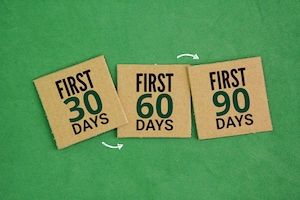
The best way to thaw this finish-line freeze is to change how you position the end of the sales cycle. You can’t close a complex enterprise deal just by repeating how great your features are. You have to prove that all the heavy lifting involved in adoption is essentially done—already bought, paid for, and de-risked.
This is where the Post-Signature Blueprint comes into play.
Don’t keep your implementation team, customer success managers, or integration engineers hidden behind the curtain until you close a deal. When you pull those teams forward into the late stages of the sales loop, you stop selling software and start selling an exact roadmap for Day 1, Day 30, and Day 90.
When you present a concrete implementation plan before the contract is signed, you build a staircase of highly manageable, pre-paved steps over a vague, terrifying mountain of operational uncertainty.
An Unbeatable Post-Signature Blueprint

To work at all, your post-signature plan can’t be a generic onboarding checklist PDF you dust off and send along with a post-meeting wrap-up email. A successful blueprint is a collaborative, customized asset that makes the buyer feel as if much of the hard work has already been taken care of. Here are the three core pillars every high-converting blueprint should include.
1. The Day-One Practical Roadmap
Here, you want to break down the first 72 hours post-signature into granular, bite-sized tasks. Show exactly who needs to be in the room, what data inputs are required, and exactly what will be accomplished. When a buyer can see a clear schedule—Hour 1: API connections; Hour 3: sandbox provisioning; Hour 24: core team walkthrough—their abstract fear of the unknown fades in the light of understanding.
If you’re not yet using question trees to decide how to address customer concerns, now would be a good time to add them to your practice.
2. The Resource Matrix (Who Does What?)
A primary anxiety for your buyer is likely the fear that your product will hijack their engineering or operations team for the next full quarter. Calm this worry by providing a clear matrix outlining all required roles and time commitments.
If your team handles data mapping, validation, and system configuration, the customer team only needs to provide access credentials and attend a one-hour verification sign-off. When a customer sees that your team is handling the heavy lifting, their operational anxiety disappears.
3. Dedicated Professional Access
Introduce your technical implementation engineers or onboarding leads to your buyer before or during the final stages of negotiation. Let your folks talk, peer-to-peer, with the buyer’s technical team. Hearing an expert say something like, “We’ve migrated thirty databases exactly like yours this year, and have a custom script that does it in four hours,” provides a level of emotional reassurance that no sales deck could ever match.
Tactical Execution: Integrating the Blueprint Into Your Sales Cycle
To deploy this strategy without slowing down your sales cycle or wasting your tech team’s time, follow a simple three-step sequence during late-stage deals.

Step 1: Plant the Seed Early
Don’t stop at presenting commercial terms during your proposal or pricing presentation. Instead, set expectations by introducing the concept of execution security. Tell your prospect something like, “Most companies give you a login and wish you luck, but for us, every contract is a commitment to an outcome. Here’s a preview of the specific blueprint we’ve built for your team’s rollout.”
Step 2: The “Technical Handshake” Call
Once you reach a verbal agreement and issue a contract for review, follow up with a dedicated 30-minute “Blueprint Deep-Dive.” Bring your implementation engineer or customer success lead onto the call. Have them walk through your exact rollout plan, showing where data will flow, how user profiles will be created, and where common pitfalls will be actively bypassed.
Step 3: Package the Blueprint as a Close Asset
Deliver your customer’s finalized, tailored blueprint alongside the contract. It should look and feel like a premium, bespoke deliverable. When your champion routes that contract to senior leadership or procurement for their final sign-off, they won’t just be sending a bill. They’ll be forwarding a bulletproof execution strategy that proves you’ve set their organization up to win, from day one.
The Ultimate Benefit: Velocity, Expansion, and Trust

Bringing your post-sale strategy into your pre-sale negotiation delivers significant dividends throughout the entire lifecycle of a deal.
- Accelerated Deal Velocity: When you tackle implementation fears head-on, you eliminate weeks of silent hesitation that stall late-stage deals.
- Protected Margins: When you sell a seamless, de-risked transition, you won’t have to slash prices to incentivize a nervous buyer. Peace of mind is a premium feature.
- Immediate Time-to-Value: When you agree on a roadmap before the ink dries on a contract, your implementation team can hit the ground running on that post-signature Monday morning without any alignment lag.
Final Thoughts

B2B buyers are inherently risk-averse. They aren’t just looking for the product with the most robust feature list. They’re looking for a vendor that poses the least risk to their daily operations and internal reputation.
Stalled deals don’t require a deeper discount or another feature video. If you’re experiencing unexpected finish line delays, take a hard look at your closing process. If you’re asking your prospects to sign a contract without providing a clear, definitive map of what happens the following business day, you’re asking them to sign up for anxiety.
Give them the confidence they need to sign by building a post-signature blueprint that shows them the heavy lifting is already accounted for. Closing is easy when your customer knows that Monday morning isn’t the start of a crisis—it’s the start of a win.
Need help building your post-signature blueprint? Reach out to mastery@maestrogroup.co to turn post-signature Mondays into victory celebrations.