Originally posted June 2021. Updated April 2026.

We often write about our information-gathering framework, DRIVE. Asking great questions (which is what DRIVE is all about) is essential for sales professionals because a lack of information is the number one risk in sales.
True professionalism isn’t limited to the time you spend speaking to prospects. That’s why Maestro’s original training and coaching focused on the Phoenix Method of sales: seven practices, memorialized as the Seven Ps, that guide sales excellence and personal growth—preparation, pay, presentation, people, product, process, and post sale.
Over the years, Maestro sales coaches and trainers have realized that there are a few more Ps involved that weren’t on the original list of seven, but guide everything we do. The first of these “hidden Ps” is “practice.” In order to get better at presenting, asking questions, or improving your process, you must practice.
PRACTICE UNTIL NOT QUITE PERFECT

Music teachers and youth sports coaches have an endless list of old sayings to encourage people to practice.
- “Practice makes perfect.”
- “Perfect practice makes perfect.”
- “Practice makes permanent.”
- “Don’t practice until you get it right. Practice until you can’t get it wrong.”
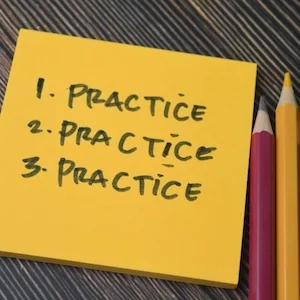
- Or just “Practice, practice, practice.”
It looks like there’s a theme, right? Perfectionism. Now, there are some things to be said for wanting to be perfect. The quotation about practicing until you can’t get it wrong makes a very good point about preparation levels. It’s much better to go into a demo with a TED-talk level of comfort with your materials rather than to have done the presentation correctly just once or twice.
However, for the most part, the fact that practice is associated in a lot of people’s minds with perfectionism is really doing practice a disservice. Perfectionism, today, is not an esteemed trait. Instead, psychologists have found that it is more effective, both in terms of performance and happiness, to encourage a growth mindset and grit than to encourage a goal of perfection that may or may not be possible or within a person’s control.
HOW MUCH PRACTICE?

You have undoubtedly heard of the 10,000 hour rule, which Malcolm Gladwell popularized with his book Outliers. His theory was that, on average, those who reach the highest level of success in their fields of excellence have practiced ten thousand hours to get there.
Now, much research since then has revealed that 10,000 hours may be a handy rule of thumb to help people realize how much effort goes into nurturing a gift into full-blown success. But it is not actually a scientific fact that putting in ten thousand hours will make you a master of anything.
Research into top athletes and chess players, for example, found that the amount of practice only explained 20-25% of their success; more powerful factors included how young they started learning their game and certain innate ability levels. Doing too much of a training activity at a time can actually cause fatigue and lower the speed of skill acquisition.
More recent research tells us that spacing out our practice (short sessions spread over time) is most effective for long-term retention and performance. A study published in 2025 in the Journal of Surgical Education found that mixing skills is also beneficial to learning. In other words, instead of AAAA BBBB (or blocked practice), try ABAB.

So, if you are trying to master a new skill or gain elite status in a skill you’re just okay at, what can you make of all these claims? First of all, know that practice is good, but it’s best if you break it up into small chunks. This is why my kids’ music teacher asks new instrumentalists to practice for seven minutes every day rather than the twenty minutes, three times a week, that I remember from my youth. Small, daily efforts avoid the fatigue problem while allowing you to build up a habit of continuously reinforcing learning.
Second, regardless of whether you target 7 minutes a day or 10,000 hours a day (hint: if the latter is your goal, take a step back and begin with 7 minutes a day of math practice), some types of practice are more effective than others.
WHAT KIND OF PRACTICE?

Classic psychology research conducted at the Max Planck Institute in the 1990s explored the value of deliberate practice. Lead author K. Anders Ericsson and his colleagues defined deliberate practice as practice that is guided by an instructor and embarked on intentionally, outside of paid work. It is structured, and involves focused attention. It is not designed around enjoyment, but around identifying and solving weaknesses.
That’s a pretty long list of characteristics. But the researchers found that they were necessary for the practice to have the greatest impact on performance. This approach to practice informs Maestro’s 40/20 rule: the concept that you should spend 20 hours outside each typical work week on professional growth. Seeking out a coach is a great way to make those hours count, as is holding yourself accountable to find areas where you need to improve.

Making practice “deliberate” is not the only way to amp up its impact. You can also use physiological cues to help with learning retention. For example, numerous studies have demonstrated that writing things down leads to better learning than typing them. Taking the time to think about how you would organize your knowledge about a prospect, and then writing note cards on the most important information, will make it more likely that you remember the info and don’t even need the notecards!
Beyond writing, anything you can do to bring more of your body into the process of practice will help to ingrain the learning. As you prepare a video presentation, stand up in front of your camera and watch your gestures on Zoom. Do they help emphasize what you’re saying, or distract from it?
STAY ON TARGET

Motivation is the single most important factor determining whether you will succeed at the goal you are trying to achieve through practice. Sometimes, naturally, the motivation will be missing!
Various strategies can help you stay motivated. For example: try a new approach to learning; take a break; set a small reward for achieving a new skill level or practicing a certain number of days in a row. The last example is the idea behind gamification. Even virtual badges can have a large motivating effect.
Best of all? Mutual accountability. If you have coworkers who are also trying to grow professionally, hold one another accountable for regular practice. Congratulate one another for your successes, and also for your perseverance!
PRACTICE FOR SALES PROFESSIONALS

The sales profession involves many different tasks which you can practice in order to improve. These include product-level understanding, communication skills such as confident email and voicemail, and presenting demos. Perhaps most important is the skill of asking great questions. Maestro recommends the use of question trees to practice navigating through discovery conversations so that you are ready for whatever the prospect throws at you.
Ready for sales coaching, or just interested in learning more about the Seven Ps? Contact mastery@maestrogroup.co.